After the Confession: When Guilt Becomes Inheritance


A Sequel to “The Guilt of the Elders”
By OLUWANBEPELUMI A. Pelumi-Folarin
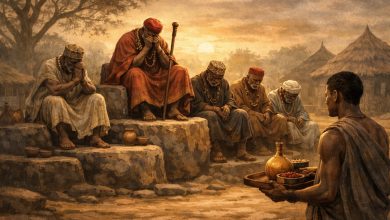
After that meeting in the village square, nothing truly returned to normal for me.
The elders rose from their stones as they always did, slowly, carefully, with the dignity of men who had lived long enough to understand the weight of time. Yet something had shifted. Their bodies stood upright, but their authority felt bent inward, as though the confession they shared had collapsed something inside them. Wisdom, I realized, does not die, it exhausts itself when it refuses to act.
What haunted me was not what they said, but what they could no longer undo.
Guilt, when it comes too late, does not redeem. It only remembers.

I began to see the elders everywhere, not only in the village square, but in our institutions, our politics, our religious hierarchies, our classrooms. Men and women entrusted with guardianship, who mistook survival for stewardship. Who confused silence with wisdom. Who believed compromise was the same as peace. They did not all intend betrayal. Some only intended comfort. But history does not judge intention, it judges consequence.
And the consequence is this generation.
A generation born into fragments. Raised among ruins but told they were buildings. Educated in systems that trained memory without consciousness, obedience without meaning, success without identity. We inherited names stripped of power, cultures stripped of context, and nations stripped of spiritual direction.
Psychologically, this damage is subtle but devastating.
A people severed from their spiritual roots develop a peculiar anxiety, a constant sense of incompleteness. They chase validation in foreign languages, foreign religions, foreign metrics of success. They work hard, yet feel hollow. They believe fervently, yet feel disconnected. They compete globally, yet feel unseen. This is not inferiority. It is dislocation.
The mind knows it has been uprooted, even when the mouth has been taught to praise the soil it was forced into.
The elders’ guilt revealed something more painful: they did not only fail to protect the culture, they failed to translate it forward. Tradition was preserved as ritual, not as philosophy. Spirituality was guarded as secrecy, not taught as consciousness. What is not taught dies quietly, even when it is respected.
And so, the children were sent away, away from ancestral frameworks of meaning, away from metaphysical grounding, away from inner authority. In their place came borrowed heavens and imported fears. A spirituality that trained them to look upward for permission instead of inward for alignment. A system that taught salvation without responsibility, submission without self-knowledge.
This was not accidental.
A people spiritually disarmed do not rebel deeply. They protest symptoms, not systems. They curse leaders, not worldviews. They change faces, not foundations. The elders sensed this too late. By the time regret arrived, the structure had already been cemented.
Yet guilt, though late, still speaks.
It speaks as warning.
It tells us this: if we inherit silence and call it peace, we will become the next elders of regret. If we repeat comfort where courage is required, history will not excuse us because we “meant well.” There is a season when preservation is no longer enough. A season when rebuilding becomes a moral duty.
This is that season.
We must move beyond mourning what was lost and confront what must now be reconstructed. Not by romanticizing the past, but by extracting its philosophical spine. Not by rejecting the world, but by refusing to disappear inside it. The future cannot be built on borrowed metaphysics. No civilization has ever risen that way.
The elders’ guilt is heavy, but it is also a gift. It reveals the cost of delay. It teaches us that wisdom without courage becomes memory, and memory without action becomes tragedy.
We must choose differently.
Let us be the generation that does not merely confess, but corrects. That does not merely regret, but reorders. That does not merely remember ancestors, but thinks like them again—with clarity, sovereignty, and spiritual confidence.
For guilt should not end in sorrow.
It should end in transformation.
And if history must speak of elders again, let it say this:
they did not only sit on stones and regret—
they stood up, and rebuilt the ground.

ABOUT US
Welcome to AFROFILM HERALD TIMES LIMITED, a premier media and entertainment company committed to celebrating and promoting the richness of African culture through storytelling. Our mission is to amplify African voices, preserve our heritage, and share authentic narratives with the world.
At AFROFILM HERALD TIMES LIMITED, we specialize in filmmaking, documentary production, content creation, and online entertainment journalism. Through visually compelling films, thought-provoking documentaries, and engaging digital content, we capture the essence of Africa’s past, present, and future.
Our passion lies in showcasing Africa’s diverse traditions, histories, and contemporary experiences in ways that inspire, educate, and entertain. With a deep appreciation for our roots and a forward-thinking approach, we strive to be a leading force in African media, bringing compelling stories to both local and global audiences.
We welcome and appreciate voluntary donations to support our administrative upkeep and continue our mission of cultural storytelling. To contribute, please reach out to us via +234 807 4441 391 (Available on WhatsApp).
Join us in our journey to redefine African storytelling and preserve our cultural legacy through the power of media and entertainment.