If Dangote Was A Filmmaker: How He’d Build “Dangote Studios” By Kolapo Mustapha

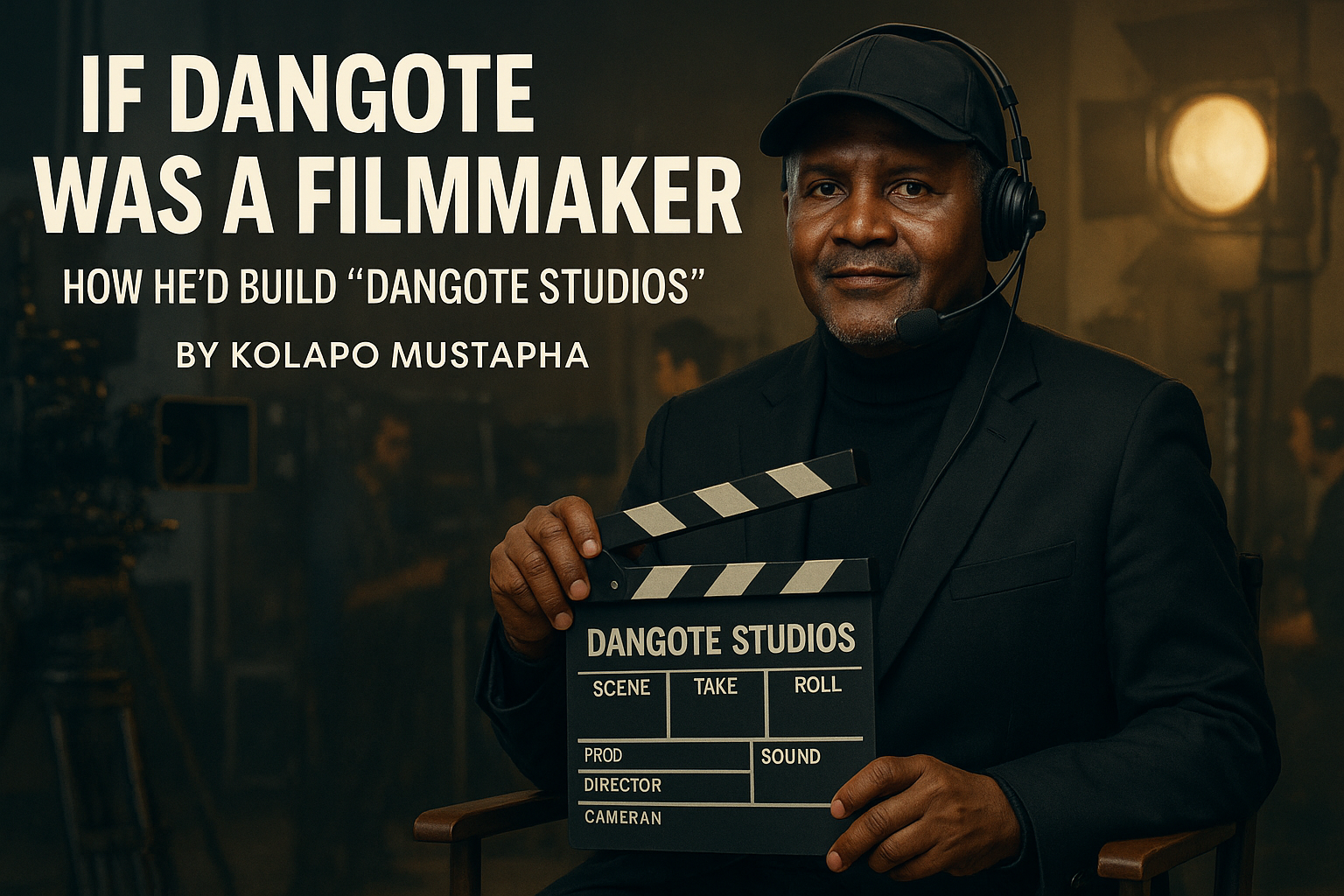
If Dangote Was A Filmmaker: How He’d Build “Dangote Studios” By Kolapo Mustapha
I’ve always been drawn to the biographies of successful people not for the glamour of their achievements, but for the quiet architecture of their minds. I read to understand how they see the world, because that vision shapes everything they do.
Among all the stories I’ve studied, Aliko Dangote’s stands out. His approach to business is not merely strategic, it’s almost philosophical. It made me realize something that kept repeating itself in every great biography: the true differentiator isn’t just access to capital, networks, or opportunities. It’s the “mental framework” behind how those resources are used.
Two people can have the same tools and still produce entirely different outcomes. The difference is not luck, it’s mindset. And Dangote’s mindset is a world of its own.
So after studying how he built industries, from sugar to cement to oil, a question began to haunt me:
“What would happen if Dangote were a filmmaker like me?”
How would he approach storytelling, production, or building a film company?
The more I tried to apply his mental framework to filmmaking, the more humbled I became. His thinking is so radically structured, so long-term, so ecosystem-focused, that it exposed how far my own reality is from that standard.
And in that moment, I understood why there is only one Aliko Dangote. Not because Africa lacks talent, but because very few people think or see the way he does.
If Aliko Dangote ever decided to become a filmmaker, he wouldn’t be chasing trends, fame, or festival validation he’d be chasing dominance. He wouldn’t build to join Nollywood; he’d build to own it.
Let’s break down exactly how “Dangote Studios” would be built, strategically, structurally, and sustainably.
1. Dangote Would Start With the Value Chain, Not Just the Camera
Dangote wouldn’t start by shooting a film, he’d start by controlling everything that makes film possible.
He’d ask:
Who owns the story IPs?
Who controls the distribution?
Who prints and masters the content?
Where’s the biggest margin leak between the storyteller and the screen?
So instead of jumping into production, “Dangote Studios” would vertically integrate the entire filmmaking pipeline.
He’d own the writers’ lab that develops stories.
He’d own the studios that shoot them.
He’d own the post-production houses that finish them.
He’d even invest in the streaming platform or cinema chain that distributes them.
In other words, before premiering the first movie, he’d already own half of Nollywood’s infrastructure.
2. He’d Build for Scale, Not for Hype
While many filmmakers chase festivals and viral clips, Dangote would chase volume.
He’d start with one thing, maybe “Dangote Originals”, a slate of family-friendly films shot across Africa and produce them consistently and profitably.
He wouldn’t compete on glamour; he’d compete on reach. Because Dangote understands something most creatives forget: in Africa, scale is sustainability.
His playbook:
* Affordable production, repeatable systems, wide accessibility.
* Distributed through cinemas, TV, and streaming in every region.
* Consistent storytelling, consistent quality, consistent schedule.
3. He’d Leverage Institutional Demand
Dangote doesn’t build on vibes; he builds on structure. So Dangote Studios would likely start by supplying steady, large-scale content to platforms, governments, and institutions.
Documentaries for tourism boards. Educational dramas for ministries. Content pipelines for African broadcasters.
That guarantees stable cash flow, establishes credibility, and opens distribution networks before moving into global entertainment.
He’d build bottom-up, not top-down.
4. He’d Use His Brand Power to Industrialize Storytelling
Dangote understands trust capital.
The “Dangote” name itself commands credibility and he’d use it to attract both local and international investors into the storytelling industry.
He’d build “Dangote Creative City”, an ecosystem for writers, cinematographers, editors, and producers, an industrial hub where training, production, and innovation converge.
He wouldn’t just make films; he’d create a filmmaking economy.
5. He’d Institutionalize Everything
Dangote’s success isn’t luck, it’s structure.
He’d run Dangote Studios like a multinational:
* A board with film, finance, and policy experts.
* SOPs for writing, production, marketing, and monetization.
* Accountability and financial discipline.
* A reinvestment culture that scales success into sustainability.
Dangote Studios wouldn’t depend on one “genius director.” It would depend on systems that outlive every individual.
6. He’d Attract Global Partners, From Cameras to Markets
Dangote knows that partnerships multiply growth.
So he’d collaborate with:
* Global camera manufacturers for cutting-edge technology.
* Streaming platforms for distribution and data analytics.
* Regional content councils for funding and export credit.
* African film commissions for tax incentives and logistics.
And still keep the core brand: “Made in Africa, Told by Africans.”
7. He’d Brand It as Industrial Pride
Dangote Studios wouldn’t scream “celebrity culture.” It would scream “national transformation”.
Imagine the tagline:
“Africa on Screen. Africa in Charge.”
He’d position filmmaking as a tool of economic empowerment and cultural sovereignty, proof that storytelling is not just art, but infrastructure.
8. He’d Scale Before Style
Once Dangote Studios becomes the backbone of film production across the continent, then he’d create “Dangote Prestige Films” his auteur division for festival and global projects.
By then, the brand “Dangote” would already mean trust, quality, and consistency.
That’s when he’d attract Africa’s best directors and producers, not as freelancers, but as partners in an ecosystem built to last.
9. He’d Think Generational, Not Seasonal
While most film projects are built for trends, Dangote builds for legacy.
He’d ensure:
* Film academies that train the next generation of storytellers.
* Regional studios that decentralize production.
* Content export pipelines across ECOWAS and the diaspora.
* Leadership succession that institutionalizes creativity.
He wouldn’t just build a studio; he’d build a cultural empire, one that outlives its founder. Dangote doesn’t chase the spotlight; he builds the system that powers it.
After walking through this mental journey, after imagining Dangote not as the titan of industry we know, but as a filmmaker like you and me, I came away with something deeper than strategy. I came away with perspective.
Dangote’s true empire isn’t cement or sugar or oil.
His true empire is *thinking*.
A way of seeing the world that turns obstacles into ecosystems and opportunities into industries.
And that challenged me.
Because when you strip away the billions, the factories, the pipelines, the boardrooms, what you’re left with is a man who built his reality inside his mind long before he built it on the land.
It made me realize that greatness isn’t in the size of what we own but in the structure of how we think.
And if we can learn to think in systems, in decades, in possibilities not just projects, then maybe the gap between a filmmaker and an industrialist isn’t as wide as we think.
Maybe the real difference is simply:
*who dares to think differently, and who commits to thinking that way every day.*

So this isn’t just a breakdown of Dangote.
It’s a mirror.
A challenge.
An invitation.
To build not with our hands first, but with our minds.
Because in the end, the mental framework you carry will either limit your world or build an empire inside it. That’s why, if you study filmmakers like Mo Abudu and Kunle Afolayan, you’d realize that one of the biggest secrets to a successful film career isn’t just cameras, budgets, or miracles – it’s the mental frame of the storyteller.

ABOUT US
Welcome to AFROFILM HERALD TIMES LIMITED, a premier media and entertainment company committed to celebrating and promoting the richness of African culture through storytelling. Our mission is to amplify African voices, preserve our heritage, and share authentic narratives with the world.
At AFROFILM HERALD TIMES LIMITED, we specialize in filmmaking, documentary production, content creation, and online entertainment journalism. Through visually compelling films, thought-provoking documentaries, and engaging digital content, we capture the essence of Africa’s past, present, and future.
Our passion lies in showcasing Africa’s diverse traditions, histories, and contemporary experiences in ways that inspire, educate, and entertain. With a deep appreciation for our roots and a forward-thinking approach, we strive to be a leading force in African media, bringing compelling stories to both local and global audiences.
We welcome and appreciate voluntary donations to support our administrative upkeep and continue our mission of cultural storytelling. To contribute, please reach out to us via +234 807 4441 391 (Available on WhatsApp).
Join us in our journey to redefine African storytelling and preserve our cultural legacy through the power of media and entertainment.