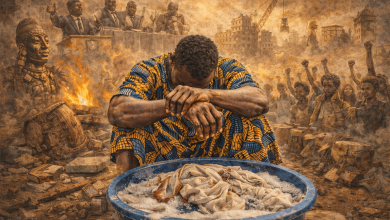
There is a peculiar pain that afflicts a people who have forgotten themselves.
It is not loud. It does not always announce itself as suffering. It often disguises itself as ambition, religiosity, productivity, or even progress. Yet beneath these performances lies a quiet confusion, a feeling that something essential is missing, even when material needs are partially met. This condition is not economic. It is psychological. And at its root lies spiritual amnesia.

Spiritual amnesia occurs when a pehople are systematically detached from the metaphysical frameworks that once gave coherence to their existence. It is not mere ignorance of the past; it is the loss of an inner reference point. For Africans, this dislocation did not happen by accident. It was cultivated, reinforced, and normalized across generations.
When a people lose their spiritual memory, the mind becomes homeless.
The African mind today often operates without an internal compass. Decisions are made, values are adopted, and aspirations are pursued without a grounding philosophy that arises from ancestral understanding of reality. The result is a chronic state of imitation—thinking through borrowed categories, measuring success by foreign standards, and interpreting life through systems that were never designed to nurture African consciousness.
This condition produces a deep psychological tension. On the surface, there is confidence. Beneath it, insecurity. On the surface, there is faith. Beneath it, fear. On the surface, there is achievement. Beneath it, disconnection. The mind knows it has been uprooted, even when the mouth has been trained to praise the soil into which it was forced.
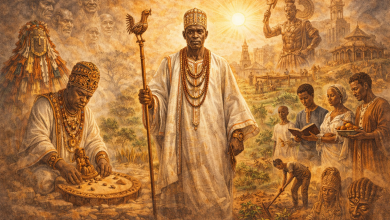
One of the most devastating effects of spiritual amnesia is the loss of inner authority. In traditional African metaphysics, the individual was not taught to be spiritually helpless. Meaning, morality, and destiny were not outsourced. They were cultivated through alignment with Ori, with community, with cosmic order. When this framework was replaced, the African mind was retrained to seek permission, validation, and salvation from external sources.
This shift did not merely change belief; it restructured psychology.
A spiritually dislocated mind becomes dependent. It doubts its own intuition. It mistrusts ancestral intelligence. It fears self-definition. Over time, this produces a people who defend systems that erase them, who ridicule their own traditions to gain acceptance, and who experience anxiety when asked to stand on their own metaphysical feet.
Another consequence is identity fragmentation. Without a coherent spiritual narrative, identity becomes layered with contradictions. One identity is worn in public, another in private. One is performed for approval, another suppressed for survival. This internal split is exhausting. It manifests as restlessness, comparison, and an endless search for belonging often in places that were never meant to feel like home.
The tragedy is that this condition is rarely recognized for what it is. It is often misdiagnosed as laziness, lack of discipline, or moral failure. In reality, it is the psychological cost of spiritual displacement. A mind severed from its roots struggles to grow upright. Yet spiritual amnesia is not irreversible.
Memory can be restored, but not through sentimentality. Reclamation requires intellectual honesty and psychological courage. It demands that Africans begin to interrogate the frameworks that govern their thinking: Why do I believe what I believe? Whose cosmology defines my sense of right and wrong? From where do I derive meaning?
Reclaiming spirituality, therefore, is not about replacing one set of rituals with another. It is about recovering inner orientation. It is about restoring the capacity to interpret existence from within one’s own civilizational consciousness. When this happens, the mind begins to heal. Anxiety gives way to clarity. Mimicry gives way to creativity. Dependency gives way to dignity.
The African renaissance will not begin in parliaments alone. It will begin in the mind. It will begin when Africans remember how to think spiritually without apology, how to ground ethics, ambition, and community in their own metaphysical heritage. For a people who remember themselves do not beg for relevance. They generate it.
Spiritual amnesia has cost Africa more than land and labor. It has cost us self-trust. But memory is returning. Quietly. Persistently. Irreversibly.
And when the African mind remembers, it will no longer ask permission to exist.

ABOUT US
Welcome to AFROFILM HERALD TIMES LIMITED, a premier media and entertainment company committed to celebrating and promoting the richness of African culture through storytelling. Our mission is to amplify African voices, preserve our heritage, and share authentic narratives with the world.
At AFROFILM HERALD TIMES LIMITED, we specialize in filmmaking, documentary production, content creation, and online entertainment journalism. Through visually compelling films, thought-provoking documentaries, and engaging digital content, we capture the essence of Africa’s past, present, and future.
Our passion lies in showcasing Africa’s diverse traditions, histories, and contemporary experiences in ways that inspire, educate, and entertain. With a deep appreciation for our roots and a forward-thinking approach, we strive to be a leading force in African media, bringing compelling stories to both local and global audiences.
We welcome and appreciate voluntary donations to support our administrative upkeep and continue our mission of cultural storytelling. To contribute, please reach out to us via +234 807 4441 391 (Available on WhatsApp).
Join us in our journey to redefine African storytelling and preserve our cultural legacy through the power of media and entertainment.